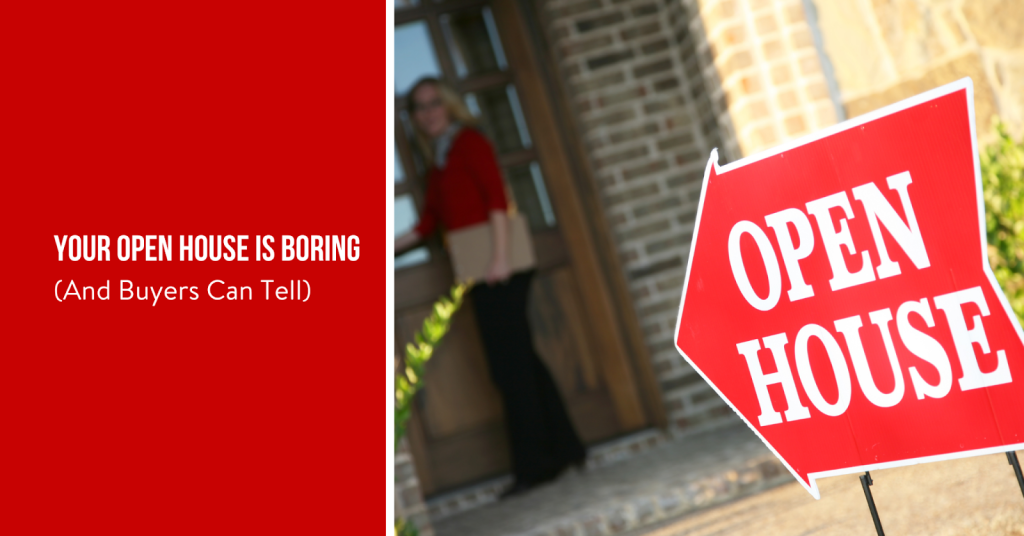
Let me be direct with you: if your open house strategy is “unlock the door, set out some cookies, and hope for the best,” you’re leaving money on the table. And your buyers? They already know everything you’re about to show them. They’ve seen the photos, toured the virtual walkthrough, and bookmarked the listing on three different apps before they ever pulled into your driveway.
So why should they get off the couch for your open house?
That’s the question every agent needs to answer before they ever put out a sign.
After more than 22 years in this industry, I can tell you with certainty that the agents who win consistently are the ones who treat the open house as an experience, not a checklist. The ones who think about what a buyer will feel the moment they walk through the door. And the ones who understand that memorable is a marketing strategy.
Why the “Standard” Open House Isn’t Cutting It
Here’s something that should stop you in your tracks: only about 4% of completed home sales originate directly from an open house visit. (Source: National Association of Realtors, 2024 Profile of Home Buyers and Sellers.) That’s not a reason to skip open houses. It’s a reason to completely rethink how you’re running them.
Today’s buyers are showing up more prepared, more financially sophisticated, and more selective than ever. The 2025 NAR Profile of Home Buyers and Sellers reports that first-time buyers have dropped to just 21% of the market, the lowest share ever recorded. The people walking through your door are often equity-rich, cash-ready, or have been comparison shopping for months. They don’t need you to read them the listing spec sheet. They’ve already read it.
What they need is a reason to feel something.
And yet, most open houses offer the same experience: bland background music, a bowl of mints on the counter, a sign-in sheet that goes nowhere, and an agent glued to their phone in the corner. Buyers notice. They move on. And they remember nothing.
What Today’s Buyers Are Actually Looking For
Around 50% of buyers still attend open houses at some point during their search. And 60-70% say they do it to visualize the space, ask real questions, and compare multiple properties in a single outing. (Source: Kelowna Real Estate Board Buyer Survey, 2023-24.)
That’s not a passive Sunday stroll. That’s an active buyer in due-diligence mode.
They want to feel what it’s like to live there. They want to picture their Sunday mornings on that patio, their kids doing homework at that kitchen island, their friends gathered around that backyard fire pit. Your job is to paint that picture for them before they even think to ask.
That’s where experience-driven open houses come in.
The Three Pillars of a Standout Open House
The most effective open houses I’ve seen (and designed) are built on three things: sensory cues, storytelling, and one unexpected moment buyers didn’t see coming.
1. Engage the Senses
Buyers don’t just see a home. They feel it, smell it, and hear it. And those sensory cues are shaping their opinion within seconds of walking in the door.
- Lighting: Layer ambient, task, and accent lighting throughout. A well-lit room doesn’t just look better. It feels warmer and more inviting.
- Scent: A subtle linen or citrus diffuser works beautifully. Avoid anything too strong or artificial. Candle-bombing a listing is a red flag, not a selling point.
- Sound: A thoughtfully curated playlist at a comfortable volume sets a mood. Streaming radio with ads does not.
- Touch: Invite buyers to sit on the bar stools, step out onto the balcony, or open the kitchen drawers. Let them interact with the space.
These aren’t small details. They’re the difference between a buyer who lingers and one who leaves in eight minutes.
2. Lead With a Story
The agents who connect best with buyers at open houses aren’t reciting square footage. They’re telling stories.
Come prepared with three short narratives:
- The seller’s story. Why did they choose this home? What did they love about it? What was their favorite evening routine in this space? You don’t need to overshare. Just give buyers an emotional anchor.
- The neighborhood story. Walkable restaurants, Saturday farmers’ markets, school zones, commute patterns, community events. Help buyers picture their daily life, not just their square footage.
- The standout feature story. That morning coffee nook. The backyard sunset view. The kitchen island where “every dinner party naturally migrated.” One vivid detail sticks in a buyer’s memory long after they’ve toured six other homes that day.
This kind of narrative-driven showing is something I write about in The INth Degree. The agents who go all IN on the experience are the ones who earn the relationship, not just the transaction.
3. Create One Unexpected Moment
This is where good open houses become memorable ones.
You don’t need a massive budget. You need one moment that buyers didn’t expect and can’t stop talking about. A few ideas that have worked beautifully:
- A “Sunday brunch” open house with local pastries, branded coffee cups, and a short neighborhood highlights talk
- A local artist’s pop-up in the living room that ties into the home’s aesthetic
- A styled outdoor setup on the patio with a handwritten note inviting visitors to “imagine your Saturday morning right here”
- A simple “What would you change or keep?” sticky-note wall that gets buyers thinking like owners, not visitors
- A QR code in each room linking to a room-specific video with design inspiration, upgrade specs, or a drone view of the backyard
These moments generate word of mouth. And word of mouth is still one of the most powerful marketing tools in this business.
Before the Open House: The Setup That Sets You Apart
The experience starts before they ever arrive. Here’s how to position it right.
Name the experience, not just the event. Instead of “Open House Saturday 1-4,” try “Sunday Champagne Garden Tour” or “Mid-Century Modern Lounge Preview.” That framing does two things: it attracts the right buyer profile, and it sets an expectation that something different is happening here.
Target a specific buyer segment. Identify 2-3 buyer types most likely to love this property, whether that’s downsizing empty-nesters, young professionals, or growing families. Tailor your staging, your talking points, and your event theme to one primary group.
Market it like it deserves attention. Use geo-targeted social ads and community groups to reach buyers within a 10-15 minute radius. Half of today’s buyers discover homes via real estate websites or social media before they ever step foot inside. (Source: NAR, 2024.) Your digital presence is the first impression. Make it one worth following up on.
During the Open House: Be Intentional About Every Interaction
Greet everyone within 30 seconds. Then ask one simple qualifying question: “Are you mostly exploring, or are you actively looking right now?” Their answer shapes everything about how you engage with them.
Use storytelling as your script. You’ve already prepared your three stories. Now deliver them conversationally, not as a rehearsed pitch. The best agents I know make it feel like you just happened to mention something interesting about the house, not like they’re reading a brochure.
Create designated experience spots. A beautifully styled balcony with two chairs and a small card that says “Ask me about the sunsets from this spot.” A mood board corner with finish samples and appliance links for buyers who are already thinking about updates. A chalkboard prompt in the kitchen: “What’s the first dinner party you’d host here?”
Don’t hover. Connect. If a couple is debating the layout in the living room, invite them into the conversation. “You both seem drawn to this space. What would you keep exactly as-is?” That question makes them feel heard and keeps them in the home longer.
After the Open House: Where Most Agents Drop the Ball
Here’s the hard truth. Most agents treat the sign-in sheet like a formality. The best agents treat it like a lead database.
Switch to a digital sign-in on a tablet or app. Capture first name, email, and buyer stage (actively looking, casually exploring, investor). Then segment those leads in your CRM and follow up within 24 hours with something personal, not a generic drip email.
Reference something specific from their visit. “You mentioned you loved the backyard. I wanted to share a couple of comparables with similar outdoor spaces in this price range.” That kind of follow-up shows you were paying attention. And it’s rare enough in this industry that it makes an impression.
For buyers who attended but didn’t connect with this property, send a short “here’s what’s available in this range” email with a curated list and a calendar link for a quick call. You’re not just selling a house. You’re building a relationship that might result in a transaction six months from now.
The Bottom Line
Open houses are not dead. Boring open houses are dead.
Today’s buyers are smart, digitally savvy, and have already done their research. They don’t need a tour guide. They need an experience that makes them feel something and an agent they actually want to work with.
When you go all IN on the details, the sensory touches, the storytelling, the one unexpected moment buyers will mention to their friends over dinner, you’re not just selling a house. You’re building your reputation as the agent in your market who shows up differently.
That reputation compounds. And it’s worth far more than any single commission.
If you want to dig deeper into what it looks like to stand out in this industry from your marketing to your mindset, check out The INth Degree. Everything I know about bold, experience-driven real estate marketing is in that book. You can also connect with me at tiffanymcquaid.com to learn more about what we’re building at SERHANT. and how we’re raising the bar for agents every day.
Your open house is a reflection of your brand. Make it one you’re proud of.
❤️ Tiffany
Sources:
- National Association of Realtors. (2024). 2024 Profile of Home Buyers and Sellers. nar.realtor
- National Association of Realtors. (2025). 2025 Profile of Home Buyers and Sellers.
- Kelowna Real Estate Board. (2023-24). Buyer Survey Data on Open House Attendance.